
Listing Fidelity // product-data integrity
Your listing should tell one version of the truth.
Scan fast. Then get a free human evaluation. A green result does not verify image copy, hidden variants, or source truth.
Scanner first → human verification next → reconcile only what actually needs work.
Before → Audit → Reconciled
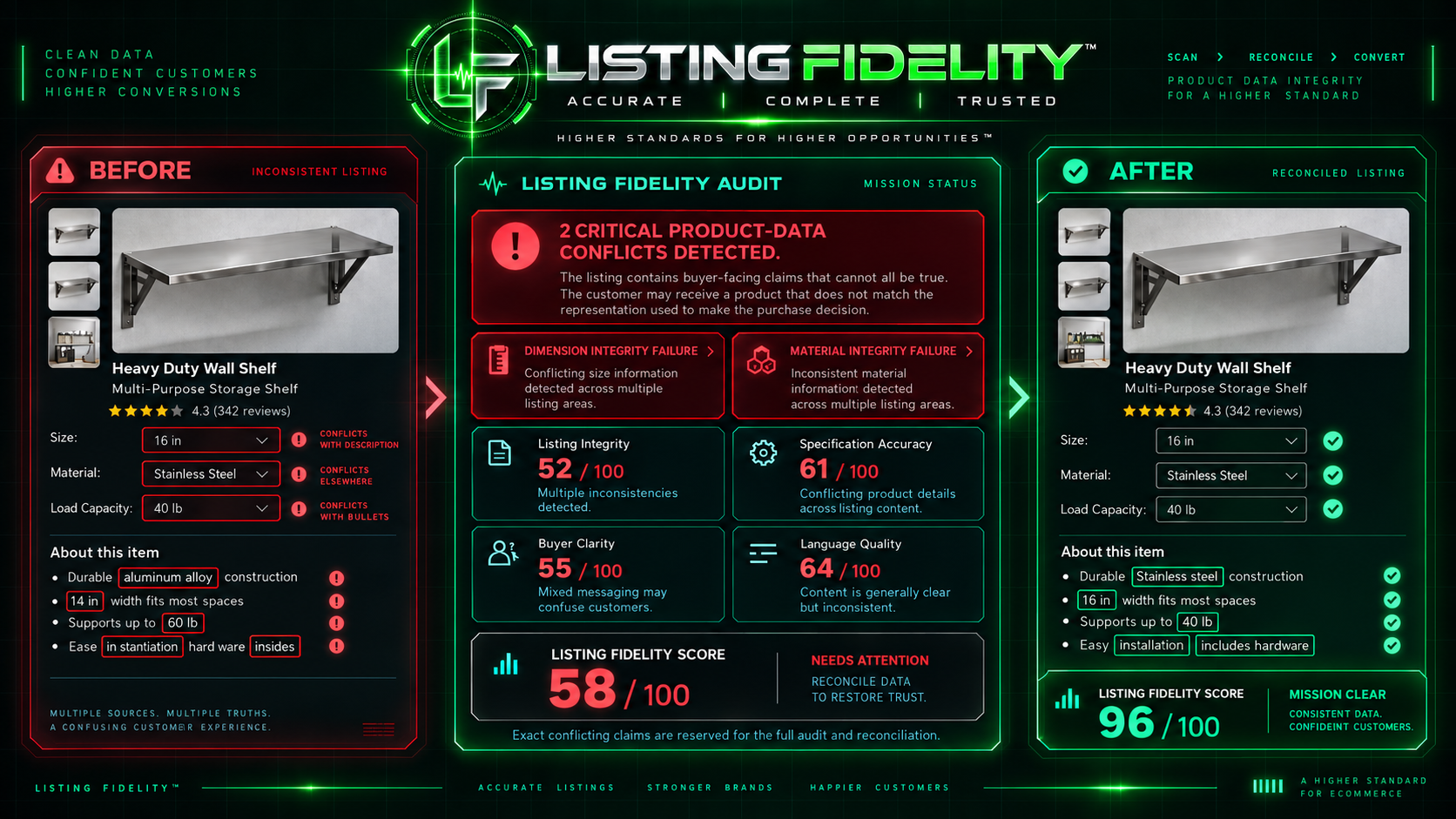
Swipe horizontally to inspect the full audit example.
We do not just make listings sound better. We make them agree.
See the Service
The scanner can surface supported text and specification failures quickly. Our free human evaluation goes further: we inspect the customer-facing presentation, including image copy and other claims automation can miss, and tell you whether the listing is already strong or needs paid reconciliation.
Scanner result ≠ final clearance
A clean scan is not the same as a cleared listing.
The scanner checks supported page content. It does not fully certify product images, baked-in image text, hidden variant claims, or authoritative source truth. Images are often where buyers look first, so if buyers can see it, it counts. Whether the scanner finds 0 issues or 50, send us the listing and we will tell you what is actually worth fixing.
Four systems // four independent scores
The listing is only as trustworthy as the systems underneath it.
Each system is scored independently out of 100. No percentage weighting lets one strength hide a critical weakness somewhere else.
Listing Integrity
We compare the customer-facing listing against itself: title, bullets, description, specifications, variants, image copy, and marketplace fields.
Does the listing agree with itself?Specification Accuracy
When an authoritative manufacturer or seller source exists, we compare listing claims against the actual product record rather than assuming consistency equals truth.
Does the listing agree with the product?Buyer Clarity
We examine whether a reasonable buyer can tell what the product is, what is included, what fits, what varies, and what the important claims actually mean.
Can the buyer understand the truth?Language Quality
We repair spelling, grammar, translation, terminology, readability, and image copy so correct product information is communicated professionally.
Is the truth communicated cleanly?What Listing Fidelity stands for
Truth first. Severity where it belongs. No manufactured alarms.
The scanner is useful only if sellers can trust it. A typo should not trigger the same response as contradictory dimensions, materials, quantities, capacities, or compatibility.
A factual contradiction is not a cosmetic defect.
If two customer-facing claims cannot both be true, that is a failure mode. It can change the product a buyer believes they are purchasing.
A listing can agree with itself and still be wrong.
We call a claim accurate only when authoritative source information supports it. Otherwise Specification Accuracy remains unverified rather than pretending certainty.
Clean listings are allowed to pass cleanly.
No red flag exists simply to create a sales opportunity. If the scanner does not find evidence of a critical conflict, it should say so.
The free scanner proves the problem without giving away the repair.
It can show category, severity, affected listing areas, and count. Human review confirms whether the signal is real; paid reconciliation produces the correction set.
A green scan is not guaranteed clearance.
The scanner is a diagnostic tool, not the final authority. Product images, baked-in image text, hidden customer-facing claims, variants, and source-truth verification still require human eyes.
The scanner diagnoses. The free evaluation verifies. Paid work resolves.
If the listing is already excellent, we should be willing to give it a thumbs-up. If human review finds problems the scanner missed—especially inside images—we identify them before any paid repair begins.
What we can accomplish
From scattered product claims to one controlled listing.
Listing Fidelity is not a generic rewrite button. It is an audit-and-reconciliation layer around the full customer-facing product record.
Cross-listing claim comparison
Surface contradictions involving dimensions, materials, quantities, capacities, compatibility, voltage, included components, and other purchase-defining facts.
Authoritative product-data checks
Compare listing claims with manufacturer specifications, seller master data, packaging, manuals, controlled records, or other legitimate source-of-truth evidence.
One product, one answer
Resolve conflicting claims so titles, bullets, specifications, variants, and descriptions stop making the customer reconcile the listing themselves.
Audit words embedded in listing images
Check buyer-facing image text against the rest of the listing and include corrected image-copy wording in the repair set.
Remove ambiguity before purchase
Clarify what the customer receives, what fits, what varies, what is included, and what the important specifications actually describe.
Finish the job professionally
Correct spelling, grammar, awkward translation, terminology, punctuation, and readability after the product truth has been reconciled.
Source-of-truth doctrine
Internal consistency and verified accuracy are different jobs.
The scanner can determine whether a listing contradicts itself from the listing alone. It needs independent authoritative product data before it can claim the underlying specifications are accurate.
Listing-only scanDoes the listing agree with itself?
→
Verified auditDoes the listing agree with the actual product?
Failure model
The scanner reacts to what the defect can actually do.
A misplaced comma is not a mission failure. Conflicting product data can be.
Product truth is contradictory.
Buyer-facing claims conflict on purchase-defining facts. Immediate reconciliation recommended.
Important product information is ambiguous or incomplete.
The listing may not directly contradict itself, but the customer cannot confidently determine a significant fact.
The facts are usable; presentation needs repair.
Spelling, grammar, translation, formatting, terminology, and lower-impact clarity issues remain worth correcting.
Listing Fidelity Scanner // V2 beta
Run the listing through mission control.
This beta separates purchase-impact factual conflicts from ordinary writing defects. Critical alarms require detected evidence; a clean scan is allowed to stay clean. Clean does not mean every image or source claim has been verified.
V2live beta
Testing Doctrine: The free diagnostic reveals the failure category, severity, affected listing areas, and buyer impact. It intentionally does not reveal the exact conflicting values or the correction path. Supply authoritative manufacturer/product data when available to verify Specification Accuracy.
MISSION CONTROL // RESULTAWAITING DATA
—Fidelity / 100
Listing Fidelity status
Add a listing to begin.
The scanner will classify factual conflicts separately from language and presentation defects.
Listing Integrity— / 100Does the listing agree with itself?
Specification Accuracy— / 100Authoritative product data required
Buyer Clarity— / 100Can the buyer understand the product and purchase decision?
Language Quality— / 100Spelling, grammar, mechanics, translation, readability.
0Critical
0Major
0Advisory
Failure modes detected
severity first // exact values withheldNo scan has been run.
Diagnostic boundary
The automated scan proves the type and severity of a detected failure without pretending it can certify every image, variant, or source claim. The free human evaluation confirms whether the listing appears healthy or needs work. Exact reconciliation, corrected output, and production-ready repair belong to the paid Listing Integrity Audit.
Human eyes complete the scan
Zero findings or fifty findings—contact us either way.
A scanner can miss image copy, dynamic content, hidden variants, or context. It can also generate a false positive. The free evaluation tells you which signals are real, which are scanner noise, and whether the full listing deserves a thumbs-up or a repair plan.
How it works
Detect → Classify → Verify → Reconcile.
Detect
Map buyer-facing claims and identify factual conflicts, ambiguity, missing information, and language defects.
Classify
Assign the correct severity. Cosmetic defects stay advisory; purchase-impact contradictions escalate.
Verify
Use seller or manufacturer source information to establish which disputed claim is authoritative.
Reconcile
Engineer one controlled listing so title, bullets, specs, variants, and image copy tell the same truth.
What earns the business
Excellent listings stay excellent with a thumbs-up. Listings with real errors get fixed.
The scanner accelerates the first pass; human review decides what is actually true. We do not manufacture work, and we do not let a green automated result become false reassurance when image copy or other buyer-facing content still needs eyes on it.
Services & pricing
We charge to resolve verified problems—not to manufacture them.
Start with a free evaluation. If the listing is already strong, we will say so. If the scanner or our human review finds real problems—including baked-in image-copy errors—the paid audit reveals, reconciles, and corrects them.
01
Listing Integrity — Single
$100 / listing
One listing audited, verified where evidence exists, reconciled, and corrected.
- Exact conflict disclosure
- Source-data verification when supplied
- Buyer clarity + language quality
- Image-copy integrity audit
- Correction set + change summary
- 1 revision • 48-hour target
02
Listing Integrity — Batch
$450 / up to 5 listings
For related products, variants, or listing families with shared product data.
- Everything in Single
- Cross-listing consistency
- Variant / quantity / unit alignment
- Shared conflict detection
- 2 revisions • 72-hour target
03
Catalog Integrity
Custom quote
For catalogs where one source-data defect can propagate across hundreds of listings.
- Bulk files and platform exports
- Source-of-truth mapping
- Variant / SKU consistency
- Repeated failure-mode detection
- Structured correction output
Mission control, not fear marketing
If the scanner says “clean,” contact us anyway.
A zero-conflict scan means the scanner did not find supported contradictions in the content it could inspect. It does not mean the images, baked-in claims, variants, or underlying product facts are fully cleared. Send us the listing for a free evaluation; if it is sound, we will tell you. If it needs work, we will show you why.